How to Get a Remote Customer Service Job With No Experience
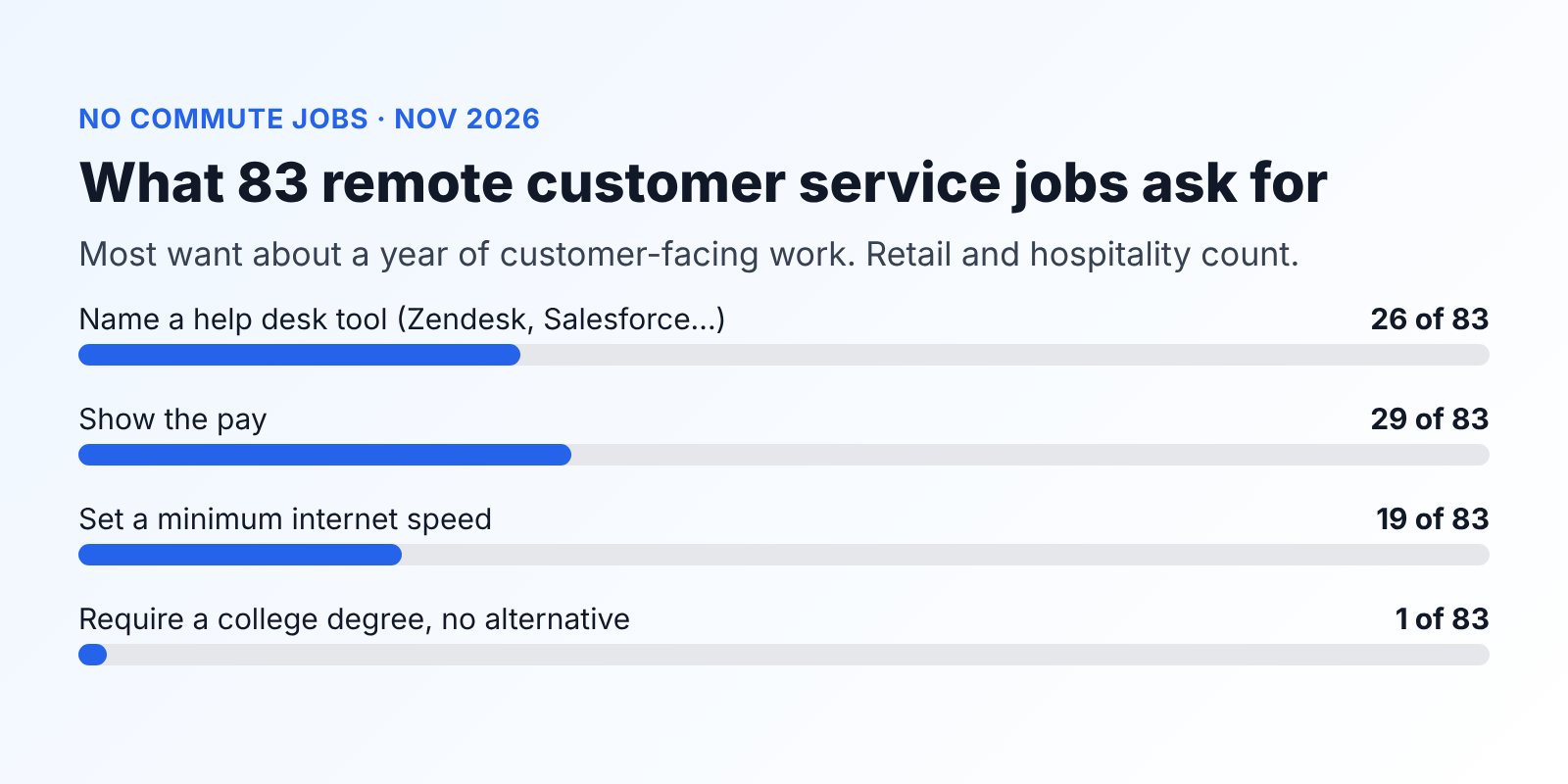
Short answer: you can get a remote customer service job without call center experience, but most employers still want to see that you've helped customers somewhere. Retail, restaurant, hospitality and front-desk work all count. Show it on your resume, check that your internet and workspace meet the listing's requirements, and start with the employers that hire beginners most often: outsourcing companies and healthcare companies.
We didn't want to guess, so we read every remote customer service listing open on No Commute Jobs on November 6, 2026: 83 listings from 37 companies, all taken from the employers' own job boards. The quotes and numbers below come from those listings.
What "no experience" really means
Very few remote customer service listings say "no experience required". What they usually ask for is about a year of working with customers, in any setting. In their own words:
- Grow Therapy (Customer Support Specialist, $20 to $24.04 an hour): "at least one year of experience in a customer-facing role, including customer support, hospitality..."
- Instacart (Bilingual Customer Experience Specialist): "High school diploma or equivalent" and "1+ year in a customer-facing role (support, retail, hospitality, call center, etc.)"
- Hinge Health (Associate Member Support Specialist, $16.96 to $28.13 an hour): "Though entry-level, this position is ideal for an applicant with 1-2 years in a member-facing role"
- Keeper Security (Consumer Support Specialist): "1+ years of experience in a customer service or support role or equivalent training"
- Sutherland (Customer Service Representative, $15 to $16 an hour): "Experience in customer service" and "High school diploma or equivalent"
So if you've worked a register, waited tables, answered phones at a front desk, or handled customers at a summer job, you already have the experience most of these employers mean. The job is to say so clearly on your resume.
What the listings ask for
Across the 83 listings:
| What the listing says | Listings | What it means for you |
|---|---|---|
| A college degree, with no alternative | 1 | Rarely needed. Eight more listings said a degree was preferred or that "equivalent experience" would do. |
| High school diploma or equivalent | 9 | The usual education requirement, when there is one. |
| Names a help desk tool (Zendesk, Salesforce, Intercom, Freshdesk, Gorgias, Kustomer) | 26 | Worth learning the basics. See step 4. |
| A minimum internet speed | 19 | Run a speed test before you apply. See step 3. |
| Spanish, or being bilingual | 15 | A second language opens more jobs. Others asked for French, German, Czech or Portuguese. |
| Shows the pay | 29 | Start with these: you know before you apply whether the job works for you. |
Step 1: Count the experience you already have
Write down every job, volunteer role or school position where you dealt with people: customers, guests, patients, members, parents. Then describe each one the way a support team would, with numbers where you can:
- "Served 80 to 120 customers per shift and handled returns and complaints" (retail)
- "Answered phones and booked appointments for a three-person office" (front desk)
- "Resolved order problems for guests during busy weekend service" (restaurant)
Put the job title you're applying for at the top of your resume, and use the listing's own words where they're true for you, like "customer-facing", "resolved issues" or "chat and email support". Applicant tracking systems and recruiters look for those words first. You can tailor your resume to a listing for free on No Commute Jobs.
Step 2: Apply where beginners actually get hired
The 37 companies hiring in our listings fall into three groups, and they treat beginners very differently.
| Type of employer | Examples hiring in November 2026 | Pay shown | Good for beginners? |
|---|---|---|---|
| Outsourcing companies (they run support for other brands) | Sutherland, SupportYourApp, TaskUs | $15 to $16/hour (Sutherland, US) | Yes. They hire often and train you, but expect shifts and strict schedules. |
| Healthcare and telehealth | Grow Therapy, Lyra Health, Hinge Health, Talkiatry, Talkspace, Equip, Included Health | $16.96 to $28.80/hour | Yes, with a year of any customer-facing work. Steady hours and good pay. |
| Tech and finance | Instacart, Coinbase, Mercury, Ramp, Wealthfront, Linear | $48,100 to $135,000/year | Harder. Most want 1 to 2 years of support experience. |
If you've never worked with customers, an outsourcing company is the fastest way in. A year there gives you the experience the healthcare and tech companies ask for. If you have a year of retail or restaurant work, apply to the healthcare companies now: their listings often say "Specialist I", "Associate" or "Coordinator", which usually means entry level.
You can see every open listing on the remote customer service jobs page and every beginner-friendly job on the entry-level remote jobs page. Both update twice a day.
Step 3: Check your setup before you apply
Remote support jobs have home-office requirements, and some employers test them during hiring. From the listings:
- Internet speed. Sutherland (US) asks for at least 10 Mbps download and 2 Mbps upload. SupportYourApp, which hires in many countries, asks for 45 to 50 Mbps download and 20 to 40 Mbps upload. Run a free speed test at the time of day you'd be working, and plug into your router with a cable if you can.
- A quiet space. Phone and video support means customers hear your background. A closed door matters more than any equipment.
- A computer and a headset. Some employers send a laptop, so read the listing first. A basic USB headset with a microphone makes you much easier to hear than laptop speakers. Our headset guide starts at about $30.
- Your schedule. 16 of the 83 listings mentioned evening, weekend or overnight hours. Shift jobs are often the easiest to get, so be honest about which hours you can take.
Step 4: Learn the basics of a help desk tool
26 of the 83 listings named the software their support team uses. Zendesk and Salesforce came up most, followed by Intercom, Freshdesk, Gorgias and Kustomer. You don't need to be an expert. Knowing what a ticket, a macro and an internal note are, and saying so in your application, puts you ahead of most beginners. Salesforce teaches its tools for free on Trailhead, and Zendesk offers a free trial you can click around in.
Step 5: Apply early, and to jobs you can actually get
- Apply in the first few days. Support roles fill fast. Set up free job alerts for customer service so new listings come to you.
- Read where the job is open to. Many remote jobs are limited to one country, or even one state (Sutherland had two listings for Virginia residents only). On No Commute Jobs, each listing shows who can apply whenever the employer says.
- Start with jobs that show the pay. 29 of the 83 did. You'll know before you spend time on an application whether it works for you.
Step 6: Prepare for the interview
Customer service interviews test how you handle people, so expect questions like:
- "Tell me about a time you dealt with an upset customer." Use a real story from any job: what happened, what you did, how it ended.
- "How would you explain [something simple] to someone who's confused?" They're checking that you're clear and patient.
- "How do you handle several chats or tickets at once?" Talk about prioritizing and not leaving anyone waiting without an update.
- "Why do you want to work remotely?" Talk about your quiet workspace and your routine, not about skipping the commute.
Some employers also give a short writing or typing test, since much remote support happens over chat and email. Practice answers out loud with our free interview practice, and see the 15 questions every remote interview asks.
Watch out for fake customer service jobs
"Remote customer service, no experience, start today" is one of the most common scam listings. Real employers don't charge for training, ask you to buy equipment through them, send you a check to deposit, or interview only over text message. If a listing feels off, look for the same job on the company's own careers page. Our guide to red flags in remote job postings lists the warning signs. All 83 listings in this guide came straight from the employers' own job boards, and No Commute Jobs re-checks every listing twice a day and removes it when the employer takes it down.
The bottom line
Most remote customer service jobs ask for about a year of working with customers, and your retail, restaurant or front-desk jobs count. Put them on your resume in support language, check your internet and workspace, and apply first to outsourcing and healthcare companies, where beginners get hired most. Then use that first job to move up.
Frequently Asked Questions
How do I get a customer service job with no experience?
Start by counting the customer-facing work you already have: retail, restaurant, hospitality and front-desk jobs all count, and most "entry-level" listings ask for about a year of that, not call center experience. Put it on your resume in support language, check that your internet and workspace meet the listing's requirements, and apply first to the employers that hire beginners most often: outsourcing companies like Sutherland and healthcare companies like Grow Therapy and Hinge Health. Apply in the first few days, because support roles fill fast. No Commute Jobs lists these remote customer service and entry-level jobs from the employers' own career pages and refreshes them twice a day, so you can apply early.
Are remote customer service jobs with no experience real, or scams?
Most are real, but "no experience, start today" is also one of the most common scam lines. Real employers never charge for training, ask you to buy equipment through them, or send you a check to deposit. If a listing feels off, find the same job on the company's own careers page. Every one of the 83 listings in this guide came straight from an employer's job board, and No Commute Jobs re-checks each listing twice a day and removes it when the employer takes it down.
Can you get a remote customer service job with no experience?
Yes, but "no experience" usually means no office or call center experience. Of the 83 remote customer service listings we read in November 2026, most that named a number asked for about one year of customer-facing work, and some said outright that retail or hospitality jobs count. If you have never worked with customers at all, outsourcing companies such as Sutherland, which list general customer service experience and a high school diploma, are the most common first step.
How much do remote customer service jobs pay?
In the listings that showed pay in November 2026, entry-level remote customer service jobs in the US paid about $15 to $26 an hour: Sutherland $15 to $16, Hinge Health from $16.96, Talkiatry $18.90, Grow Therapy $20 to $24.04, Lyra Health $24 to $26 and Equip $25 to $26. Salaried roles started around $45,000 to $60,000 a year (Charlie Health, Mercury, Ramp, Wealthfront).
Do you need a degree for a remote customer service job?
Usually not. Of the 83 listings we read in November 2026, only one (Wealthfront) asked for a bachelor's degree with no alternative. Eight more said a degree was preferred or that equivalent experience would do, and nine asked for a high school diploma or equivalent.
What equipment do you need to work customer service from home?
A reliable computer, a quiet place to work and a stable internet connection. Listings that name a speed asked for anything from 10 Mbps download and 2 Mbps upload (Sutherland, US) to 50 Mbps download and 40 Mbps upload (SupportYourApp, outside the US). A USB headset with a microphone helps on phone and video calls. Some employers send a laptop; read the listing before you buy anything, and never pay an employer for equipment.
Can I get a remote customer service job outside the US?
Yes. Many remote customer service listings are open in Latin America, Europe, Africa and Asia, mostly at outsourcing companies like SupportYourApp, Sutherland and TaskUs and at software companies like JumpCloud and Twilio. They usually ask for strong English (often C1 level) and sometimes a second language. Check the location line on each job before you apply.